The Packaging and Packaging Waste Regulation (PPWR), Regulation (EU) 2025/40, is the legislation governing all packaging placed on the European Union, covering chemical safety, conformity documentation, recyclability, and recycled content.
How is PPWR Changing Packaging Compliance?
The PPWR entered into force on 11 February 2025 and generally applies from 12 August 2026, when it replaces most of the previous Packaging and Packaging Waste Directive framework. Some obligations apply later as delegated acts, implementing acts and technical standards are adopted.
How do Converters Know Which PPWR Guidelines Apply?
A consequential structural shift sits beneath the PPWR timeline, as the regulation redefines roles across the supply chain, distinguishing between manufacturers, suppliers, importers, distributors, and fulfilment service providers, and assigning each its own obligations. For a converter, the first practical step is establishing which of those roles, or which combination of them, applies to a given product, because that determination governs what the business is accountable for.
What are the Current PPWR Requirements?
Three requirements apply to anything placed on the EU market: demonstrable chemical safety, compliance with PFAS restrictions for food-contact packaging, and complete conformity documentation for every packaging item.
- Chemical safety. Where a converter acts as the PPWR manufacturer, it must demonstrate compliance. Where it acts as a supplier, it must provide the manufacturer with the information and documentation needed to complete the conformity assessment. In either case, substances of concern in their packaging need to be minimised, and that the combined concentration of lead, cadmium, mercury, and hexavalent chromium does not exceed 100 mg/kg. The threshold is carried over from the previous directive, so it is not new. What has changed is the requirement for documented proof rather than a supplier’s verbal assurance, and the limit applies to every component of packaging across the supply chain, including inks, coatings, and adhesives.
- PFAS restrictions. For food-contact packaging, including food supplements and nutraceuticals, converters must additionally show compliance with concentration limits for per- and polyfluoroalkyl substances or “Forever Chemical”, which apply whether the PFAS are intentionally added or unintentionally present.
- Conformity documentation. This is where the majority of immediate effort sits, requiring a conformity assessment for each packaging item, with importers carrying a parallel duty to verify that their non-EU manufacturers have done the same. That assessment is supported by technical documentation under Annex VII, retained for five years for single-use packaging or ten for reusable formats, and by an EU Declaration of Conformity under Annex VIII kept for the same period. The process is self-assessment, so no notified body is involved, but the documentation must exist and withstand inspection.
What Are the Upcoming PPWR Requirements?
The obligations carrying the most significant design consequences arrive in a defined sequence between 2028 and 2030, and each requires substrate or structural decisions rather than documentation alone.
- 12 February 2028: certain formats, including tea and coffee filter bags and fruit and vegetable stickers, must be compostable under Article 9.
- 12 August 2028: packaging must carry a harmonised label showing its material composition to guide correct sorting, either printed directly or accessible via a scannable QR code, based on the accompanying implementing acts.
- 1 January 2030: From 2030, or later if the required delegated criteria are delayed, packaging subject to the design-for-recycling requirements will generally need to achieve at least recyclability performance grade C, corresponding to 70% recyclability by weight.
Why Do Later Deadlines Require Decisions Now?
Packaging redesign lead times mean that a requirement applying in a few years realistically requires a decision being made today.
Sourcing, testing, and rolling out a new packaging construction frequently takes a year or more, and that timeline compounds where multiple formats across a portfolio are affected. A recyclability or recycled-content threshold binding at the start of 2030 therefore needs material selection and validation underway well before the deadline is in view. Converters operating without a mapped transition plan tend to find the window for acting decisively has closed by the time the obligation becomes visible, leaving reactive substitution as the only option.
How Does Printing Affect PPWR?
Printing sits directly within PPWR scope, because inks and supporting coatings and adhesives are packaging components subject to the same substance restrictions and documentation requirements as the substrate itself.
This has two practical consequences.
- Heavy metal limits and the requirement to minimise substances of concern apply across every applied layer, meaning converters need documented compliance data from their ink suppliers rather than general assurances.
- Ink chemistry influences whether a packaging format can meet recyclability thresholds. Ink migration behaviour and de-inking or repulpability performance both affect how a finished pack is assessed, and those characteristics may influence at the printing stage rather than during recycling.
Substrate compatibility is equally consequential, since a printing process that cannot run more potentially more recycling-compatible paper-based and mono-material structures effectively or use less environmentally impactful water-based inks will constrain which flexible packaging formats a converter can realistically offer.
How Does Digital Printing Support PPWR?
Water-based digital inkjet addresses several PPWR pressure points at once, covering substance compliance, substrate flexibility, and the overproduction reduction that supports wider sustainability reporting.
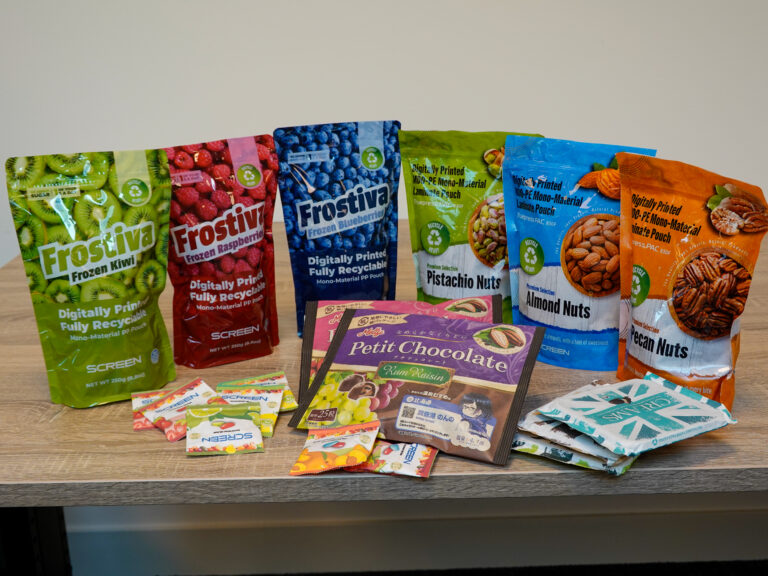
Water-based inks, like those used by the SCREEN Truepress PAC 520P, minimise volatile organic compounds (VOCs), simplifying the substance-of-concern documentation burden compared with systems carrying a heavier chemical load. SCREEN’s Truepress PAC Ink sets are formulated for compliance with the EuPIA Exclusion Policy for Printing Inks, the Swiss Ordinance, and Nestlé Guidance for packaging inks, giving converters established reference frameworks when assembling documentation for food-contact, hygiene, nutraceutical applications.
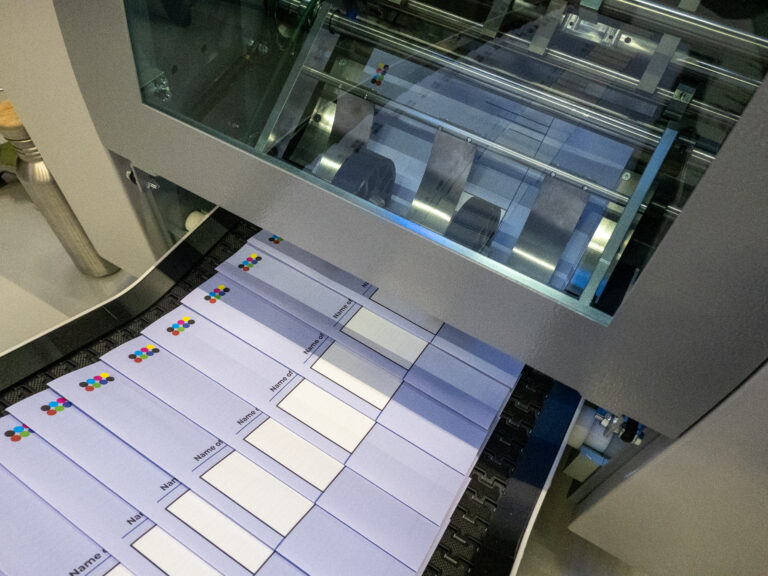
Substrate capability matters even more as the 2030 recyclability threshold approaches. The Truepress PAC 520P is a water-based inkjet press built for paper-based flexible packaging and compatible with a wide variety of substrates, allowing converters to trial and scale paper-based structures without a separate production platform. And as digital printing requires no plates or cylinders, testing a new substrate carries none of the tooling cost that makes analogue trialling expensive, lowering the barrier to the required validation work.
The overall converting workflow is the third factor. Print-on-demand workflows remove the need to hold large inventories of pre-printed material, which becomes commercially significant when the harmonised labelling obligation takes effect in August 2028 or 24 months after the relevant implementing act enters into force, whichever is later. and stocks of non-compliant packaging become obsolete. The digital agility to produce current-specification packaging in the quantity required, when it is required, limits that exposure and contributes directly to printing waste reduction targets reported under wider sustainability commitments.
What Does the PPWR Mean for Packaging Converters?
The PPWR establishes a compliance baseline that is set to tighten, and it is unlikely to be the final regulatory intervention affecting packaging design.
Individual member states may adopt stricter national measures, other regions are introducing their own recyclability criteria on differing timelines, and the existing phase-in schedule remains subject to revision.
Converters who treat sustainability as an operational principle rather than a discrete compliance exercise, by adopting water-based printing, testing more recyclable substrates, and conducting life cycle assessments generally find that successive requirements arrive with limited additional overhead.
The practical work of the coming years is identifying solutions that hold cost-effective production and sustainability compliance together rather than trading one against the other, and developments in ink formulation, substrate structure, and on-demand production have made that balance considerably more achievable.
If you would like to learn more about compliance or how inkjet printing can support your business, you can reach out to Juan Cano, SCREEN Business Development Director for Flexible Packaging Printing who can walk you through where your packaging or label converting portfolio‘s printing solutions sits against the PPWR requirements at marketing@screeneurope.com.